
Implementing Country Participants
Technical Notes and Guidance Documents
ontributing to the literature on carbon pricing for climate change mitigation.
The World Bank’s partnership for market readiness (PMR), through grant support and technical assistance, supported 23 emerging economies and developing countries in building their institutional and human capacities to design, institute, and implement carbon pricing instruments, such as emission trading systems, carbon taxes, and or carbon crediting mechanisms along with underlying infrastructures such as monitoring, reporting and verification (MRV) and registry systems. As the PMR winds down and its successor – the partnership for market implementation (PMI) – becomes operational in 2021, the time is opportune to take stock of and analyze key lessons learned from the decade of PMR experience. This report draws lessons from the PMR’s decade-long country, technical work, and policy analysis work programs and relates the insights captured through its extensive country participant consultation process, its online surveys, and feedback from its contributing country partners and World Bank task teams. The lessons documented in this report are expected to provide practical insights for other developing countries planning to design and implement carbon pricing initiatives. In addition, the lessons learned on the PMR process, as well as the grant implementation process, are likely to help similar initiatives, including the PMI, to adopt improved program design and governance options that support efficient funds allocation, deployment, and implementation.
A standardized framework is needed to assess countries’ capacity building needs to participate in carbon pricing and international carbon markets. The World Bank initiated the development of the mitigation action assessment protocol (MAAP) in 2015 to drive meaningful assessment of diverse climate actions. Pilots results showed that MAAP provides a transparent and relatively easy-to-use framework to help countries identify strengths and opportunities for improvement. Future implementation of the tool will seek to address identified challenges such as collecting evidence, identifying capacity building priorities, and providing guidance on communication strategies. This report summarizes key findings and lessons learned from pilots.
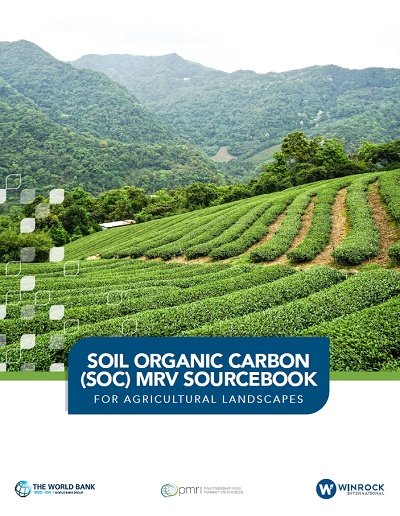
Despite the significant potential of soil to sequester organic carbon, there are challenges to implementing carbon sequestration projects. For example, changes in soil carbon can be relatively small in magnitude per unit area and slow to be fully achieved, while its measurement and monitoring can be difficult and costly depending on the focus of the assessment. This sourcebook is designed to provide a conceptual foundation for soil organic carbon measurement and monitoring in croplands and grazing lands or rangelands. It provides methods and simple step-by-step guidance to produce reliable soil carbon measurements across a variety of settings and contexts, with comparisons on what frameworks, approaches, or methods to choose relative to the goal of the assessment, costs, feasibility, and uncertainty. Although greenhouse gas (GHG) emissions (methane, CH4, or nitrous oxide, N2O) associated to agricultural land management can be significant and must be assessed to calculate total net GHG reductions of a project, this sourcebook focuses on soil carbon and specifically changes in soil carbon in agricultural lands that are a direct consequence of land management.